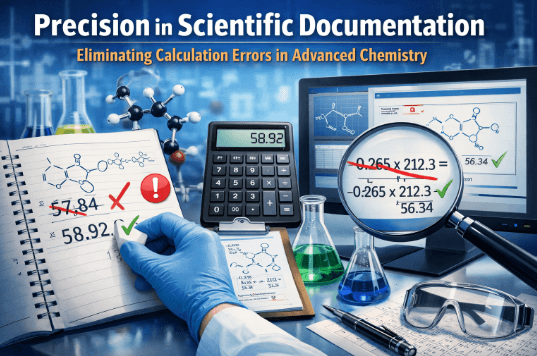
Mastering the art of scientific documentation is a rite of passage for every aspiring scientist. In any rigorous college curriculum, the transition from generalised science to specialised work within a laboratory demands a tremendous leap in technical rigour. When it gets too much, it is perfectly natural to wish for someone to take my chemistry class for me, at least to catch up. However, it takes great precision to write an accurate lab report, to say that it demonstrates exactly what happened. It is also important to say that it accurately portrays a truthful, mathematically correct narrative that can be replicated by anyone in the future.
The Foundation of Accuracy in the Lab
In an advanced laboratory setting, the margin for error is razor-thin. A single misplaced decimal or a failure to account for ambient temperature can render a week of research useless. This high-stakes environment is a primary driver of student stress chemistry students face globally. When the mental toll of re-running experiments is high, a student must develop a systematic approach to calculation and measurement before even stepping into the laboratory.
Identifying Common Calculation Pitfalls
In advanced chemistry, errors generally fall into three categories: systematic, random and human. While systematic errors are often due to equipment calibration, human errors in the post-lab calculation phase are entirely preventable through rigorous proofing and utilising step-by-step chemistry calculations to verify results.
1. Molarity and Dilution Discrepancies
Many lab reports fail during the peer-review process because of simple dilution errors. When you are tasked with creating a $0.05\text{ M}$ solution from a $2.0\text{ M}$ stock, the formula $M_1V_1 = M_2V_2$ is the standard, but units must remain consistent.
Technical Example: If you want to prepare a solution consisting of 250 mL with 0.05 M concentration, your equation should be:
\begin{align*}
(2.0\text{ M}) \times (V_1
$$V_1 = 6.
Another mistake to avoid is mixing millilitres and litres ($0.25\text{L}$) midway through a calculation without making a correct conversion.
2. Significant Figures and “Rounding Drift”
Clarity is king, but in professional scientific writing, significant figures, or sig figs, are the supreme law. Science teaches us not to round our answers prematurely in a multi-step calculation, as rounding drift occurs, causing a wide deviation from the correct answer.
In order to make sure that measurements are kept intact, it’s important to ensure that at least two “guard digits” are maintained during intermediate steps, and rounding should only be done to appropriate significant figures in the final answer.
Mastering error propagation analysis is essential for ensuring your data maintains the precision dictated by your laboratory instruments.
Advanced Stoichiometry and Yield Calculations
Stoichiometry is the heart of any quantitative chemistry assignment. To avoid errors, always map out your dimensional analysis conversion path:
- Grams of Reactant $\rightarrow$ Moles of Reactant
- Moles of Reactant $\rightarrow$ Moles of Product (using the balanced equation)
- Moles of Product $\rightarrow$ Theoretical Yield in Grams
If your actual yield is higher than 100%, it is a signal to re-examine your measurements. You likely have a “wet” product or impurities that were not accounted for. Many students find that using stoichiometry problem-solving guides helps them visualise these conversion bridges more clearly.
See also: Fire Risk Assessment and Prevention Strategies
Dimensional Analysis: The Measurement “Spell-Check”
Never write a number without its unit. Dimensional analysis acts as a built-in error detection system. If you are to solve for something such as mass but you realise the units can be reduced to $L/mol$, you have recognised a mistake before even turning the work in. It is little details such as this which make the difference between a passing grade and a phenomenal one in a competition.
Leveraging Academic Resources for Growth
At other times, it can prove to be simply overwhelming to handle so much information provided through an online course. When an individual feels that he or she is having difficulty making the necessary connections between lab results and a professional-quality written report, it can prove to be an excellent idea to look for a higher level of advanced chemistry academic resources.
Reviewing how professional educators handle chemistry lab report formatting provides a vital template for your future success. Using high-quality references allows you to internalise the formatting standards required for professional scientific journals.
Final Tips for Error-Free Reports
- Double-Check the Balanced Equation: Every calculation starts here. If the coefficients are wrong, the stoichiometry is fundamentally flawed.
- Utilise Measurement Software: Tools like Excel allow you to set up automated formulas, reducing the risk of manual calculator entry errors.
- Peer Review: Fresh eyes often spot “obvious” units-of-measure mistakes that you may have overlooked during a long lab session.
Conclusion: Precision as a Skill
The goal of a chemistry education is to develop a rigorous, analytical mind. By slowing down during the calculation phase and treating every unit with respect, you transform your lab report from a chore into a piece of scientific literature. Whether you are tackling a difficult assignment or preparing for a career in research, precision is the most valuable tool in your kit.